

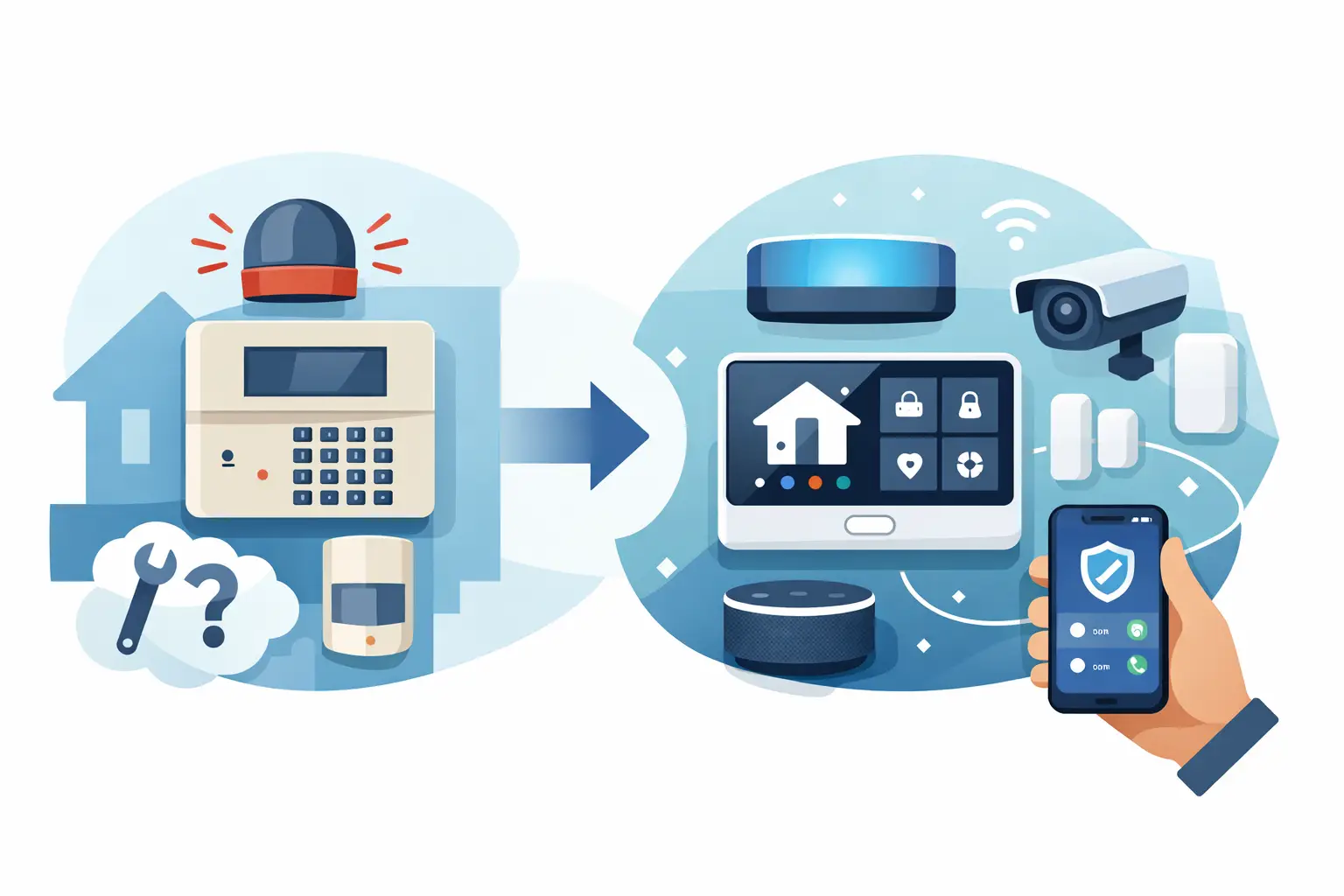
An alarm that still makes a noise is not necessarily an alarm that is still protecting your property properly. Ageing keypads, unreliable sensors, obsolete control panels and batteries that no longer hold their charge can all leave gaps in your security. Knowing how to upgrade old alarms starts with understanding what is already installed, what condition it is in and what you need the system to do now.
For homeowners, landlords and businesses across Bolton and the North West, an upgrade can be anything from replacing a tired control panel to installing a completely new, app-connected system. The right answer depends on the property, the existing wiring and the reliability of the equipment – not simply on the age of the alarm.
How to upgrade old alarms: assess the existing system first
The first step is a proper on-site assessment. Older alarm systems can be hardwired, wireless or a mixture of both, and a professional inspection establishes whether the existing equipment can be retained safely. An alarm panel may be outdated while the cabling and some detection points remain perfectly serviceable. Equally, a system that appears to work may have hidden issues such as damaged cables, poorly positioned sensors or zones that have been disconnected after repeated faults.
Start by considering the practical warning signs. Frequent false alarms, a panel that displays fault messages, an alarm that will not set consistently or a system with no obvious way to replace batteries all deserve attention. If you have moved into a property and do not know the alarm code, installer details or service history, that is another good reason to arrange a survey rather than trying to reset equipment yourself.
The external bell box also needs checking. Its purpose is to provide an audible and visible deterrent, but older units can become unreliable or look neglected. A modern external sounder with its own battery backup can be a sensible part of a wider upgrade.
Check what still has value
A good upgrade does not automatically mean removing every component. Sound cabling can make a hardwired or hybrid system an economical and dependable option, particularly in larger homes, offices, shops and premises with multiple rooms. Existing door contacts and motion detectors may sometimes be compatible with a new panel, although their age, condition and positioning should be assessed before they are kept.
However, it is rarely wise to build a new system around equipment that is already causing faults. Reusing unsuitable detectors to reduce the initial price can create unnecessary call-outs and frustration later. The aim is reliable protection, not merely keeping the old alarm running for another year.
Choose between a panel upgrade and a new installation
A panel upgrade can work well where the wiring is in good order and the current layout still covers the property effectively. Replacing the control panel, keypad, backup battery and external sounder may bring an older hardwired system up to date. It can also allow for additional detectors, user codes and remote control features where appropriate.
A full replacement is usually the better choice if the existing system has recurring faults, poor coverage or equipment that is no longer supported. It may also be preferable after an extension, loft conversion, office refurbishment or change of use. A property often changes far more than its alarm system does. New access points, altered internal partitions and added valuables can all mean the original design no longer makes sense.
Wireless systems are particularly useful where running new cables would be disruptive, such as finished homes, rental properties or smaller commercial spaces. Modern wireless equipment is far more capable than many people expect, but it still needs professional positioning, secure programming and a planned battery maintenance schedule. A hybrid system can be a practical middle ground, retaining useful existing wiring while adding wireless protection to new areas.
Decide what your upgraded alarm needs to protect
An effective alarm is designed around how people enter, use and secure a property. A survey should look beyond the front door. Side doors, rear access, patio doors, accessible windows, garages, outbuildings and connecting doors can all affect the specification.
For a typical home, this may mean door contacts at key entry points, motion detection in circulation areas and a clearly audible external sounder. A pet-friendly detector may be needed if animals are left indoors, although no detector choice removes the need for sensible placement. Large dogs, furniture near sensors and open staircases can all influence the design.
For a business, the priorities may include separate setting areas, multiple user codes, staff access patterns and protection for stock rooms, offices or till areas. A shop that opens early and closes late may need a different approach from a small office occupied only during weekday hours. Landlords may also require a system that is straightforward for new occupants to use, with clear responsibility for testing and reporting faults.
It is worth deciding whether app control would genuinely help. A smart alarm can let authorised users set or unset the system, receive notifications and check status from a phone. This is useful for busy households, landlords and business owners, but it should not be chosen solely because it is fashionable. The system still needs reliable detection, clear user management and a suitable internet connection. App access should be protected with strong passwords and removed promptly when a tenant, employee or contractor no longer needs it.
Do not overlook the parts people rarely see
The most visible part of an alarm is usually the keypad, but the less obvious components often determine whether it performs when needed. Every modern specification should account for battery backup, so the system can continue operating during a power cut. Wireless sensors and external sounders also have batteries that require periodic attention.
Detector placement matters just as much. A motion detector aimed at a radiator, direct sunlight or a frequently moving curtain can lead to false activations. A door contact fitted to a poorly aligned door may not set reliably. Engineers consider the room layout, likely entry routes and normal daily activity before fixing equipment in place.
Audibility should be considered too. An internal sounder needs to alert people inside the building, while the external sounder provides a deterrent outside. In some circumstances, alarm signalling or monitoring may be appropriate, but this should be discussed in relation to the risks, the property type and the response arrangements available. There is no single package that suits every home or business.
Avoid a like-for-like replacement without a survey
It can be tempting to replace an old keypad with a similar-looking unit or buy a standalone smart kit and fit it yourself. This may appear cheaper, but it can leave problems unresolved. Older systems may use incompatible wiring arrangements, detectors may have developed faults, and a new panel still has to be programmed, tested and commissioned correctly.
There are also safety considerations. Alarm control equipment is commonly connected to the mains supply, so electrical work should be carried out by a competent professional. Tampering with an existing system without knowing how it is configured can trigger alarms, damage equipment or leave zones inactive without the owner realising.
A professional installer can explain what can be retained, where the trade-offs are and what the upgrade will cost before work begins. ESI provides tailored surveys and recommendations rather than assuming that every old alarm needs the same replacement.
Test, service and keep control of access
An alarm upgrade is only complete once it has been tested in real operating conditions. Each detector, door contact, sounder, keypad, app function and backup battery should be checked. You should also be shown how to set and unset the alarm, respond to common messages and arrange future servicing.
Keep a record of authorised users and review it regularly. Change codes when staff leave, tenants change or a keyholder arrangement is updated. For app-controlled systems, remove old user accounts rather than sharing one login between several people.
Regular servicing helps identify low batteries, worn components and changes to the property before they become faults. It also gives you the opportunity to adjust the system after building work, a new pet, altered business hours or changes in how the premises are used.
An old alarm does not have to be a weak point in your property security. A careful survey and a system designed for the way you live or work can turn an uncertain, ageing installation into protection you can rely on every day.