

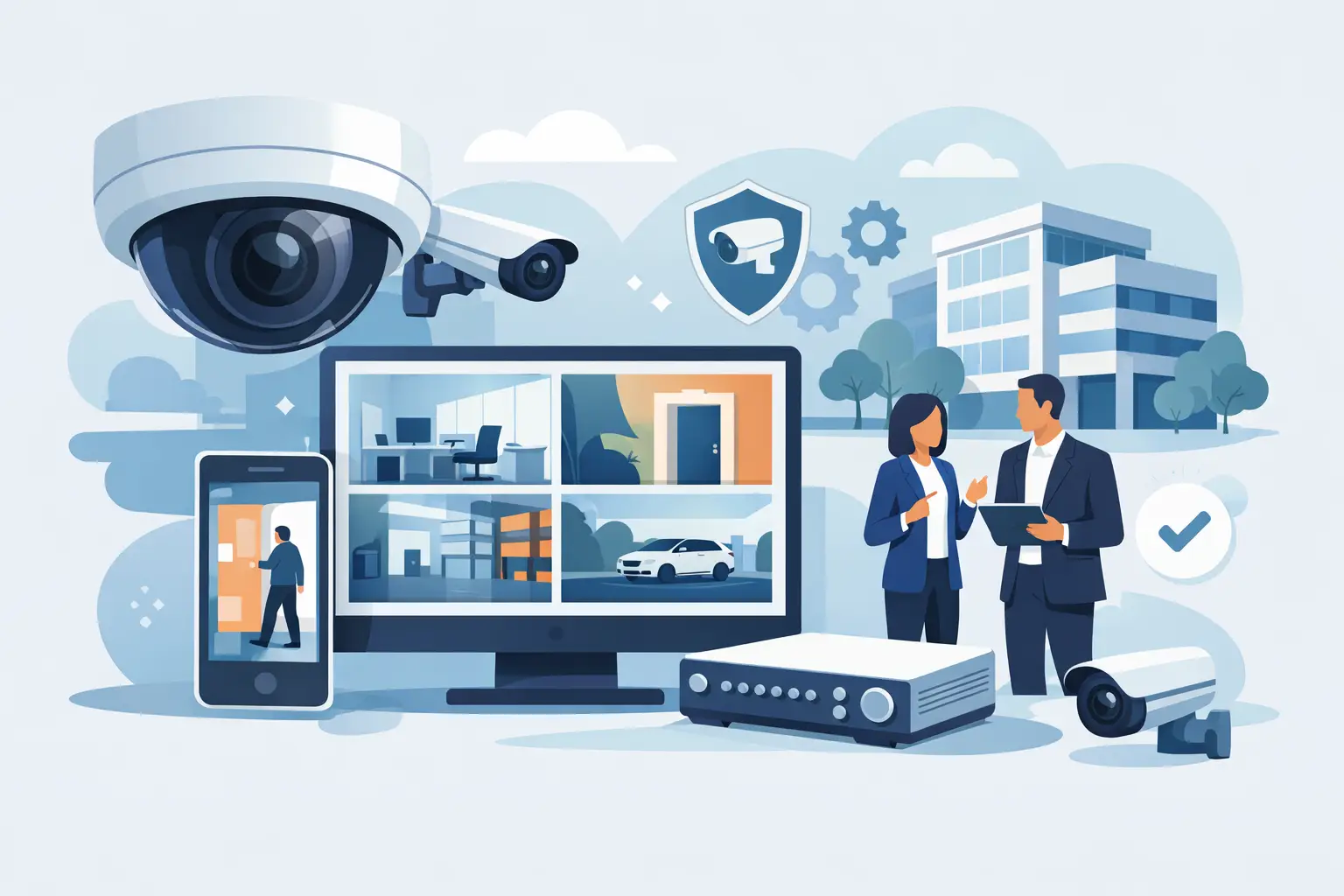
A camera above the front door is not a commercial CCTV system. For most businesses, the real challenge is working out what needs watching, how footage will be used, and whether the system will still do its job six months after installation. A good commercial CCTV buying guide starts there, not with a catalogue of cameras.
If you are responsible for a shop, office, warehouse, workshop or mixed-use premises, the right system should support day-to-day security without creating hassle. That means clear images, dependable recording, sensible coverage and a layout that matches how people actually use the site. It also means avoiding the common mistake of buying on price alone and ending up with blind spots, poor night footage or storage that runs out too quickly.
What a commercial CCTV buying guide should help you decide
Before looking at camera types or recorder sizes, be clear on the job the system needs to do. Some businesses want visible deterrence at entrances and car parks. Others need evidential footage for incidents at tills, stock areas or delivery points. In many cases, you need both.
That difference matters because a deterrent-led system and an evidence-led system are not always designed in the same way. A wide-angle camera may show general activity around a forecourt, but it may not capture enough facial detail at a doorway. Equally, a tightly focused camera on a cash point will not tell you what happened across the rest of the room. The right balance depends on your premises, your risks and your budget.
A proper site survey usually makes these decisions much easier. It helps identify where people enter, where stock is vulnerable, where lighting drops off, and where a camera may be blocked by shelving, signage or daily activity. That practical planning stage is often what separates a system that looks fine on paper from one that performs properly in use.
Start with risk, not with camera numbers
Many buyers ask how many cameras they need. The better question is what needs covering and why. A small office may only need external entry points, reception and a rear access route. A retailer may also need till coverage, shop floor visibility, a stock room and recorded access to staff-only areas. An industrial unit might prioritise shutters, loading bays, perimeter approaches and vehicle movements.
More cameras do not automatically mean better protection. Too many poorly placed cameras can create unnecessary cost without improving usable footage. In some cases, fewer cameras with better positioning and the right lens choice will deliver a stronger result.
Think about the incidents you would want to review. Theft, trespass, damage, false claims, staff safety concerns and out-of-hours access all place slightly different demands on the system. Once those priorities are clear, specification becomes much more straightforward.
Choosing cameras for indoor and outdoor use
The most suitable camera type depends on the environment. Dome cameras are often chosen indoors because they are tidy, unobtrusive and well suited to offices, receptions and retail spaces. Bullet cameras are commonly used outside where a more visible deterrent is helpful and longer viewing distances are needed. Turret cameras can be a good middle ground, particularly where infrared performance and image clarity in lower light are important.
Resolution matters, but it is not the only thing that matters. Higher resolution can give more detail, but only if the camera is positioned properly and the recorder is set up to retain that quality. There is little benefit in paying for very high resolution if storage settings later compress the footage so heavily that key detail is lost.
Night performance is another area where buyers often get caught out. Many incidents happen when light levels are poor, especially around service yards, rear entrances and car parks. You should check how the system performs after dark, whether supplementary lighting is needed, and whether strong backlighting from signs or headlights will affect image quality.
Commercial CCTV buying guide to storage and recording
Recording is just as important as capture. If footage cannot be found quickly, has already been overwritten, or is too poor to use, the camera has not done its job.
Most commercial systems record to a network video recorder or digital recorder, depending on the type of cameras installed. The key consideration is retention. How long do you need to keep footage for? A busy retail site with multiple high-resolution cameras recording continuously will use storage much faster than a small office recording mainly on motion.
There is no universal answer because it depends on your operational needs and any policy requirements you follow. What matters is setting realistic expectations from the start. A business owner may assume they have thirty days of footage, only to find the system is retaining far less because quality settings, frame rates and activity levels were not properly considered.
Remote viewing can also be useful, especially for managers overseeing more than one site or checking access outside opening hours. It should be a convenience, not the main selling point. Stability, secure setup and ease of reviewing recorded events are more important than flashy app features.
Coverage, blind spots and practical placement
One of the biggest differences between a professionally planned system and an off-the-shelf approach is camera placement. Entrances should usually capture faces at a usable angle, not just the tops of heads. External cameras need to account for weather exposure, glare and changes in seasonal light. Internal cameras should avoid being obstructed by doors, racking, displays or future layout changes.
Height is another trade-off. Set a camera too high and you may reduce the chance of tampering, but you can also lose useful identification detail. Set it too low and it may be more vulnerable to damage. There is usually a sensible middle ground, but it depends on the area being watched.
This is also why a floor plan alone rarely tells the full story. Ceiling heights, cable routes, power availability and the way the premises operates each day all affect what is practical. Businesses that open early, close late or handle deliveries at the rear often need a different layout from those that mainly receive visitors through a single front entrance.
Don’t overlook compliance and staff considerations
Commercial CCTV is not just a technical purchase. You also need to think about lawful use, signage, who can access footage and how recordings are handled. If cameras cover staff areas, shared entrances or public-facing parts of the premises, your responsibilities need to be clear.
That does not mean the process has to be difficult, but it does mean the system should be installed and managed properly. Good advice at the buying stage can help avoid problems later, particularly if multiple people in the business may review footage or if the site has customer-facing areas where privacy expectations need to be respected.
It is also worth being realistic about internal use. If you want CCTV partly to support staff safety, the positioning and quality requirements may differ from a system installed only for external deterrence. The same applies if footage may need to be shared with police or insurers after an incident.
Wired, wireless and future expansion
For most commercial premises, wired CCTV remains the more dependable option. It is generally better suited to stable recording, consistent image quality and long-term reliability. Wireless products may have a place in some smaller or more awkward spaces, but they are not always the right answer for busy sites where reliability is critical.
Expansion is worth thinking about at the outset. You may only need four cameras today, but if the recorder is already full and the cabling routes have not been planned for growth, adding cameras later can become more expensive than it needs to be. A little forward planning goes a long way, especially for businesses expecting layout changes, additional stock space or upgraded access control.
Why installation and aftercare matter
Even good equipment can perform badly if installation is rushed. Focus, angle, cable protection, recorder setup, user permissions and remote access all need proper attention. The same goes for maintenance. Lenses get dirty, settings get changed, hard drives fail and site layouts evolve.
That is why many businesses prefer dealing with a local installer who can survey, specify, fit and support the system over time. For example, a company such as Enga Security Installations can advise on what suits the premises rather than simply supplying boxes. That tends to lead to a system that works better in practice and is easier to maintain.
If you are comparing quotations, look beyond headline price. Ask what is included in the survey, installation, setup and handover. Check whether you will be shown how to review footage, export clips and manage users. A cheaper quote can become poor value very quickly if important parts have been left out.
Buying the right system for your site
The best commercial CCTV purchase is rarely the most expensive or the most heavily advertised. It is the one that fits the risks of the property, captures the right detail in the right places, and remains dependable once the novelty has worn off.
If you approach the decision with clear priorities, realistic expectations and proper site planning, you are far more likely to end up with a system that supports the business rather than creating extra work. A sensible CCTV system should give you confidence when something happens and just as importantly, reassurance on the many days when nothing does.