

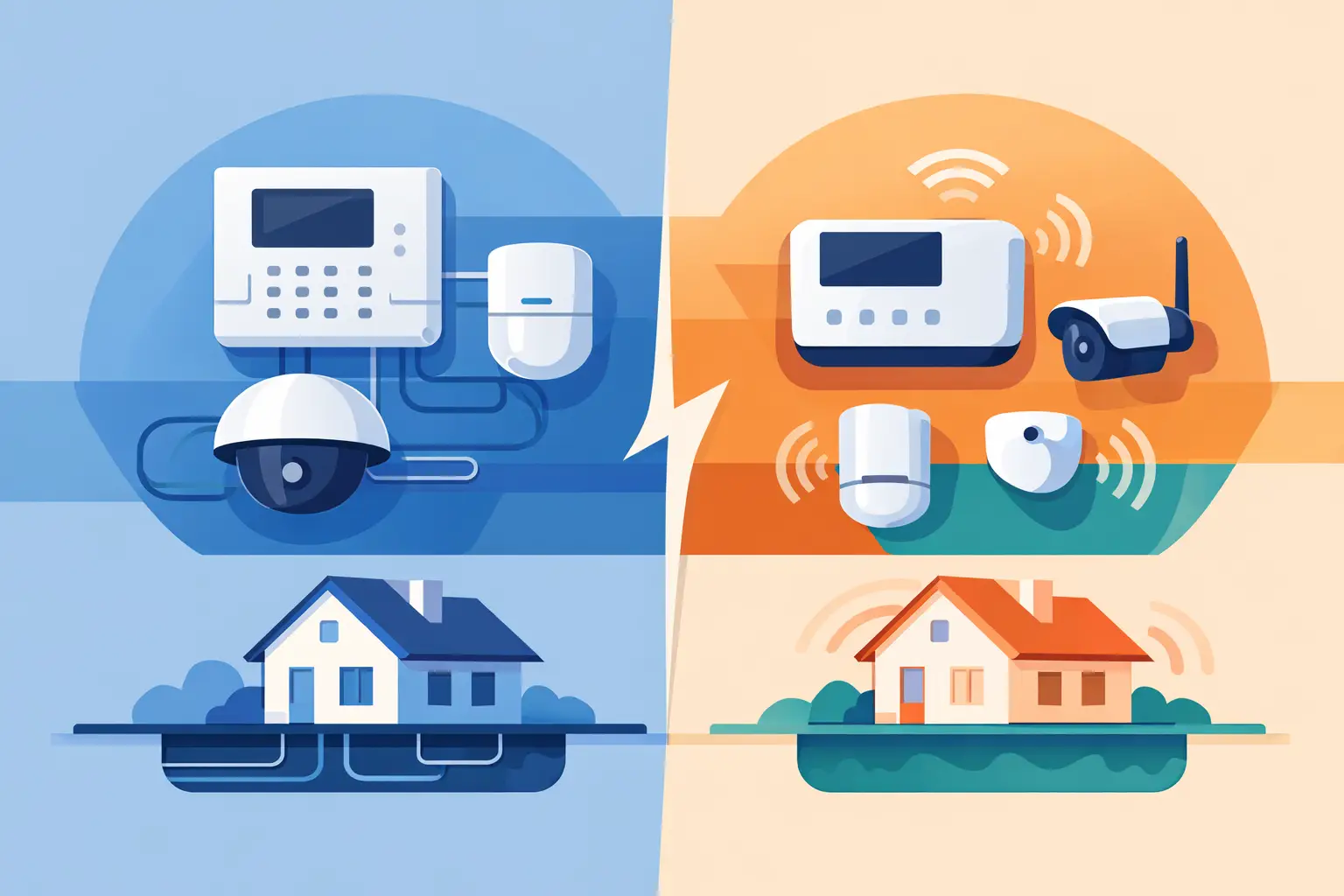
When people compare wired vs wireless alarms, they are usually trying to answer a very practical question: what will protect the property properly without causing avoidable cost or disruption? The right answer depends less on trends and more on the building itself, how it is used, and what level of reliability and control you expect day to day.
For some properties, a hardwired alarm is the sensible long-term choice. For others, a wireless system is quicker to fit, easier to expand, and a better match for modern living. The key is understanding where each option works well, and where the trade-offs start to matter.
Wired vs wireless alarms: the main difference
A wired alarm uses physical cabling between the control panel, detectors, keypads, sounders and other devices. This usually makes it a strong option for properties where cables can be run neatly during a renovation, extension or new build, or where an older wired system is being upgraded.
A wireless alarm uses radio signals to communicate between devices. Sensors and accessories are battery powered, which means far less disruption during installation. In many occupied homes and business premises, that alone makes wireless a very attractive option.
Neither system is automatically better in every situation. A professionally specified wireless alarm can be highly dependable, while a properly installed wired system can offer excellent longevity. The question is which suits your property, your layout and your priorities.
When a wired alarm makes more sense
Wired alarms are often chosen for permanent, long-term protection where reliability and consistency are top priorities. Because the devices are physically connected, there is no reliance on each detector having its own battery for normal operation. That can reduce ongoing maintenance at device level, although the system will still need regular servicing.
They are particularly well suited to larger properties, commercial sites, and buildings with complex layouts where a stable, fixed infrastructure is preferred. If you already have cabling in place from an older system, reusing or upgrading that setup can also be cost-effective.
Another advantage is that wired systems are often ideal where there is work already taking place. If walls are open, ceilings are being altered, or the property is undergoing refurbishment, installing cables becomes much simpler and less intrusive.
The drawback is the installation process. In a finished home, shop, office or rental property, running new cables can mean lifting floors, accessing lofts, chasing walls or working around decoration. That does not make it impossible, but it can make the job slower and less convenient than a wireless alternative.
When wireless alarms are the better fit
Wireless alarms have improved significantly over the years and are now a strong choice for many domestic and small business installations. Their biggest advantage is flexibility. Devices can often be positioned with far less disruption, which is useful in occupied properties where you want a clean installation without major building work.
This makes wireless systems well suited to homes, flats, rented properties, smaller offices, retail units and buildings where decoration needs to be preserved. They are also useful when customers want to add protection gradually, such as starting with key access points and extending the system later.
Wireless can also work well for people who want smart control, app access and easier upgrades. Modern systems often integrate neatly with everyday use, whether that means setting the alarm remotely, receiving alerts, or managing different user permissions.
The trade-off is maintenance. Wireless sensors rely on batteries, and while battery life can be very good, they do not look after themselves. A system still needs proper servicing, and batteries need replacing at the right time rather than being left until a fault develops.
Reliability: what matters in real use
Reliability is often the first concern people raise in the wired vs wireless alarms debate. There is a common assumption that wired always means reliable and wireless always means compromise. In practice, that is too simplistic.
A well-installed wired system is extremely dependable, particularly where the cabling is sound and the system has been maintained properly. But age, wear, poor previous workmanship and outdated components can still cause faults.
Wireless systems, when chosen correctly and fitted professionally, are also very reliable. Signal strength, device placement, panel position and the quality of the equipment all matter. Problems tend to arise when systems are chosen on price alone, fitted without a proper survey, or left without servicing.
That is why the property survey matters so much. Thick walls, awkward layouts, outbuildings, multiple floors and commercial environments all affect what will work best. Good alarm design is not just about choosing wired or wireless. It is about making sure the system suits the building.
Installation time and disruption
For many customers, the practical difference comes down to disruption. A wireless alarm is usually quicker and cleaner to install. That can be a major advantage if you are living in the property, running a business from it, or managing tenants.
A wired alarm may take longer, especially if there is limited access for cables. In the right property, that extra work is worth it. In the wrong one, it can create unnecessary mess and cost.
This is where straightforward advice matters. There is little point forcing a wired solution into a finished property if a wireless setup will provide the protection required with less upheaval. Equally, if a building is being renovated and cabling is easy to install, choosing wired can make excellent sense.
Cost now versus cost over time
The upfront cost of wireless alarms can sometimes be attractive because installation is often faster. Less time running cables may mean lower labour costs in some properties. On the other hand, the equipment itself can cost more than equivalent wired components.
Wired systems may involve more installation labour, especially on retrofits, but they can be very economical over the long term in the right setting. Wireless systems may save disruption at the outset, but they bring ongoing battery replacement and servicing requirements that should be factored in.
That is why it helps to look beyond the initial quote. The real question is not simply what costs less on day one. It is which system gives you dependable protection, sensible maintenance, and the least hassle over the years you expect to use it.
Which is better for homes?
In many homes, wireless alarms are the practical winner because they can be installed neatly without disturbing decoration. They are particularly useful for occupied houses, flats and properties where homeowners want app control, easy expansion or a straightforward upgrade from an older setup.
Wired alarms are still a very good option in larger homes, major renovations or properties that already have alarm cabling in place. If the infrastructure exists, keeping or improving a wired system can be a smart move.
The best domestic solution often depends on how the house is used. A family home, a rental property and a vacant renovation project all have different needs. The alarm should match that reality rather than following a one-size-fits-all rule.
Which is better for businesses?
For small to medium-sized businesses, the choice depends heavily on the premises. A shop, office or unit that is already finished and occupied may benefit from the speed and flexibility of wireless installation. That keeps disruption to trading or staff routines to a minimum.
For larger or more permanent commercial premises, wired systems often remain attractive because they suit fixed layouts and can form part of a wider security setup. If access control, CCTV and alarm monitoring all need to work together, planning the whole system properly becomes more important than choosing on a single feature.
For landlords and business owners, maintenance should also be part of the decision. The system needs to remain dependable month after month, not just work well on installation day.
A hybrid system can be the right answer
Sometimes the best answer is neither fully wired nor fully wireless. Hybrid systems combine both approaches, allowing existing wired components to be retained while adding wireless devices where cabling would be awkward.
This can work particularly well in extensions, refurbished buildings or premises with a mix of old and new areas. It can also be useful when customers want to upgrade gradually rather than replace everything at once.
A good installer will not push a single type of system regardless of the building. They will look at the access, the risks, the daily use of the property and the practicalities of future maintenance before making a recommendation.
How to choose properly
If you are deciding between wired vs wireless alarms, start with the property, not the product. Consider how easy it is to run cables, whether the building is occupied, whether you want smart control, and how likely the system is to be expanded later.
Then think about support after installation. Even the best alarm system needs servicing, testing and the occasional upgrade. Choosing a setup that fits your building is only part of the job. Making sure it is installed and maintained properly is what turns it into dependable protection.
For homeowners, landlords and businesses across Bolton and the wider North West, that usually means getting a proper survey and a recommendation based on the building rather than guesswork. At ESI, that practical approach is what helps customers avoid overcomplicating the decision.
The best alarm is not the one that sounds most advanced on paper. It is the one that suits the property, works reliably every day, and gives you confidence when you lock up and walk away.