

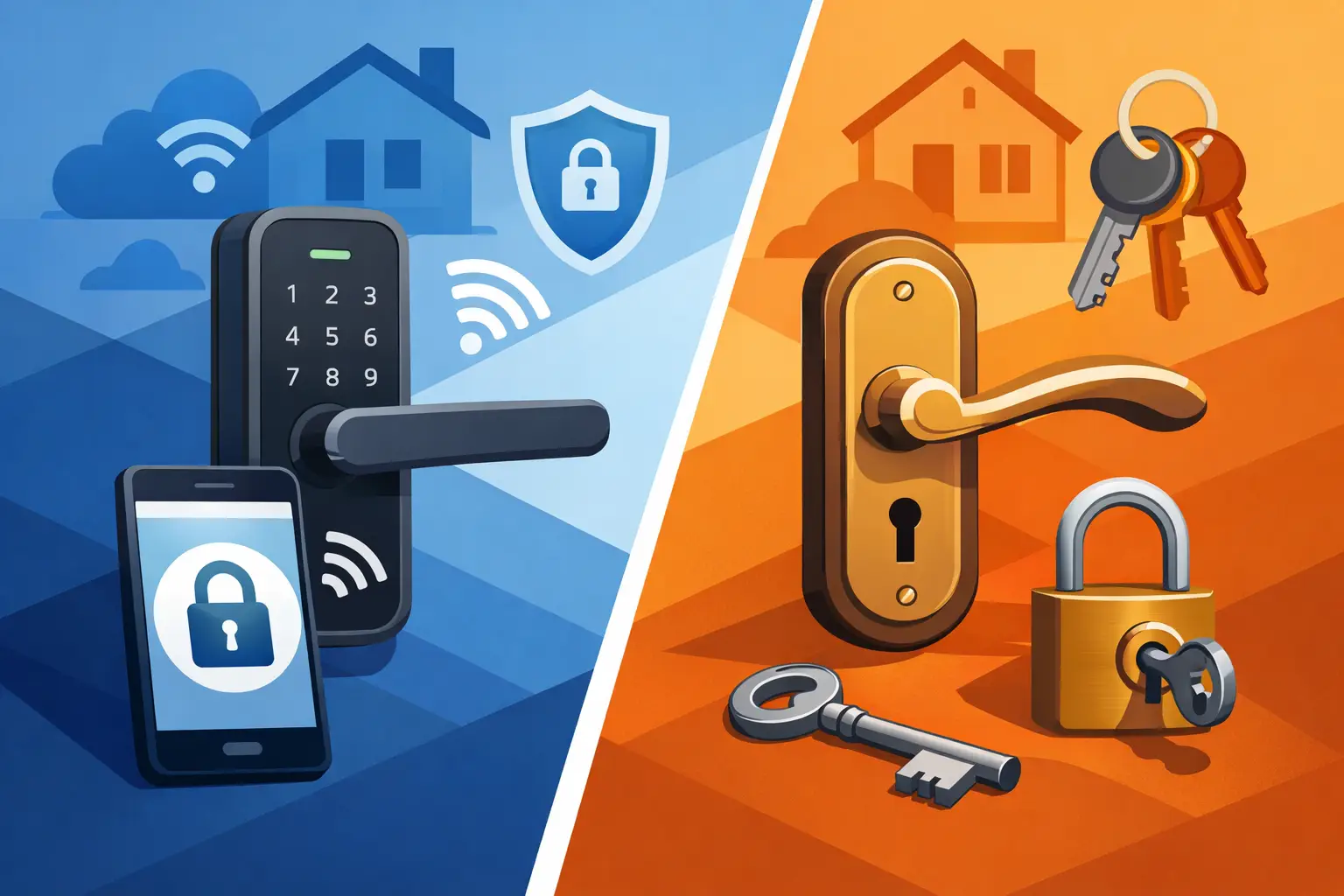
You usually notice a lock when it lets you down. It might be a stiff key on a wet evening, a lost set of keys before opening the shop, or the worry that spare copies are still in circulation after a tenant moves out. That is where the question of smart locks vs traditional locks becomes a practical one rather than a fashionable one. The right choice depends on how the property is used, who needs access, and how much day-to-day control you want.
For some properties, a well-fitted mechanical lock remains the best answer. For others, digital access solves genuine problems that keys never handled particularly well. What matters is not choosing the newest option by default, but matching the lock to the risk, the door, and the people using it.
Smart locks vs traditional locks: the real difference
Traditional locks rely on a physical key and mechanical components. That can mean a standard cylinder lock, mortice lock, night latch, or a multipoint locking system on a modern composite or uPVC door. They are familiar, widely understood, and often very effective when the hardware is of good quality and fitted properly.
Smart locks replace or add to that key-based setup with digital access. Depending on the model, entry may be through a keypad, app, fob, fingerprint reader, or temporary code. Some are standalone, while others form part of a wider security setup with alarms, CCTV, or access control.
The key point is this: smart does not automatically mean more secure, and traditional does not automatically mean outdated. Security comes from the full setup – the door, frame, lock standard, installation quality, and how the system is managed over time.
Where traditional locks still make strong sense
Mechanical locks are often the better fit when simplicity and proven reliability matter most. A good traditional lock does not depend on Wi-Fi, app permissions, mobile phone battery life, or staff remembering the right code. In many homes, that straightforwardness is exactly the appeal.
They also suit doors that already have strong physical security and do not need frequent access changes. If you own your home, do not regularly grant entry to others, and simply want a secure, insurance-friendly lock fitted to a good standard, a traditional solution may be all you need.
For some commercial settings, traditional locks still work well too, especially for low-traffic storerooms, secondary doors, or premises with a small trusted keyholder group. They can also be a sensible fallback as part of a broader security plan.
That said, traditional locks have their own weak points. Keys can be lost, copied, or not returned. If someone leaves with a key they should no longer have, the solution may involve changing cylinders or replacing hardware. Over time, that can become inconvenient and more costly than it first appears.
The strengths of traditional locks
The biggest strengths are familiarity, mechanical dependability, and lower upfront cost. There is little training involved. Most people know how to use them, and when they are properly specified for the door and fitted well, they provide solid day-to-day protection.
They are also less vulnerable to user error in the digital sense. There are no weak passcodes, no forgotten app settings, and no issues caused by poor mobile signal. For many households, that simplicity brings peace of mind.
When smart locks are the better option
Smart locks come into their own where access changes regularly or where convenience has genuine value. A landlord managing tenant turnover, a business with multiple staff, or a homeowner tired of hiding keys for family members may benefit from digital entry.
Instead of cutting extra keys, you can issue codes, fobs, or permissions. Instead of changing a lock after someone leaves, you may simply remove their access. Some systems also provide an audit trail, which can be useful for businesses wanting clearer control over who entered and when.
For residential customers, smart locks can be especially useful as part of a wider connected security setup. If the property already uses a smart alarm or CCTV system, digital locking can add another layer of convenience and control. For example, you may want to let in a tradesperson at a set time without handing over a permanent key.
For commercial premises, the appeal is often less about novelty and more about administration. Managing access for staff, cleaners, or contractors can be far easier through a digital system than through a ring full of keys.
The trade-offs with smart locks
Convenience always has to be balanced against setup quality and ongoing management. Not every smart lock suits every door, and not every property needs app-based entry. Battery-powered devices need checking. Users need clear permissions. In commercial settings, the system should be planned so that staff turnover does not create confusion or security gaps.
There is also the question of backup. If a device loses power or a mobile phone is unavailable, there must be a reliable way to regain entry. Good systems account for that from the start, whether through a physical override, emergency power option, or managed access method.
A poorly chosen smart lock can be frustrating. A properly selected and professionally fitted one can make everyday security much easier to manage.
Security is not just about the lock itself
This is where many comparisons go wrong. People often ask whether smart locks or traditional locks are safer, as if the answer sits in the lock alone. In practice, the security of any entry point depends on more than that.
The strength of the door matters. So does the frame, the alignment, the hinges, the condition of the multipoint mechanism, and whether the cylinder or locking body meets appropriate standards. A strong lock fitted to a weak door is still a weak point. Equally, a quality digital lock installed on an unsuitable door may not deliver the protection people assume.
That is why property surveys matter. The right recommendation should start with the actual entrance, not a generic product preference. In some cases, retaining a traditional high-security cylinder on a solid door is the best route. In others, a digital lock integrated with access control is more practical and just as secure when correctly installed.
Cost, maintenance and long-term value
Traditional locks usually cost less at the start. For straightforward domestic upgrades, that can make them the obvious choice. If your needs are simple, there is no reason to complicate matters.
Smart locks tend to involve higher upfront costs, especially when they are part of a larger access or alarm system. But the longer-term value can be stronger where access changes often. If you regularly replace keys, change cylinders, or manage multiple users, digital control may save time and reduce disruption.
Maintenance also looks different. Mechanical locks need occasional adjustment, lubrication, or replacement as parts wear. Smart locks may need battery changes, software updates, and periodic checks to ensure the hardware and permissions are working as intended. Neither option is truly maintenance-free.
For landlords and business owners, this is often the deciding factor. The cheapest purchase is not always the lowest-cost option over several years.
Which option suits your property?
For a typical family home, a traditional lock is often still the right fit if the goal is dependable physical security with minimal fuss. If you want easier access for family members, fewer spare keys, or integration with other security devices, a smart lock may be worth considering.
For rented properties, it depends on turnover and management style. A single long-term tenancy may not need digital entry. A property with more frequent changeovers may benefit from the control a smart system offers.
For small businesses, the question is usually operational. If only one or two trusted people need access, traditional locking may be enough. If staff, contractors, or cleaners need managed access at different times, smart locking or access control can make everyday running much simpler.
In the North West, we often see customers assume they have to choose one side completely. In reality, mixed setups are common and often sensible. A business might use digital access on the main entry and traditional locks on internal doors. A homeowner may prefer a smart front door lock but keep conventional locking elsewhere.
Smart locks vs traditional locks: choose what you can manage confidently
The best lock is the one that suits the property and will be used properly every day. If you want a simple, proven solution and your access needs rarely change, traditional locks remain a strong choice. If you need flexible access, better oversight, or a more convenient way to manage entry, smart locks can offer real advantages.
What should not be overlooked is installation quality. Even the best hardware can underperform if it is badly fitted or mismatched to the door. A practical recommendation, based on how the building is actually used, will always outperform guesswork.
If you are weighing up a change, it helps to think less about what sounds modern and more about what solves the problem in front of you. Good security is rarely about chasing features. It is about choosing a system you trust when the door closes behind you.