

A camera system is only useful when it gives you a clear, dependable record at the moment you need it. The analogue vs IP CCTV decision affects picture quality, installation requirements, remote viewing and the cost of maintaining your system over time. For homes, shops, offices and managed properties, the right answer depends less on the latest specification and more on the building, risks and existing cabling.
Analogue vs IP CCTV: the main difference
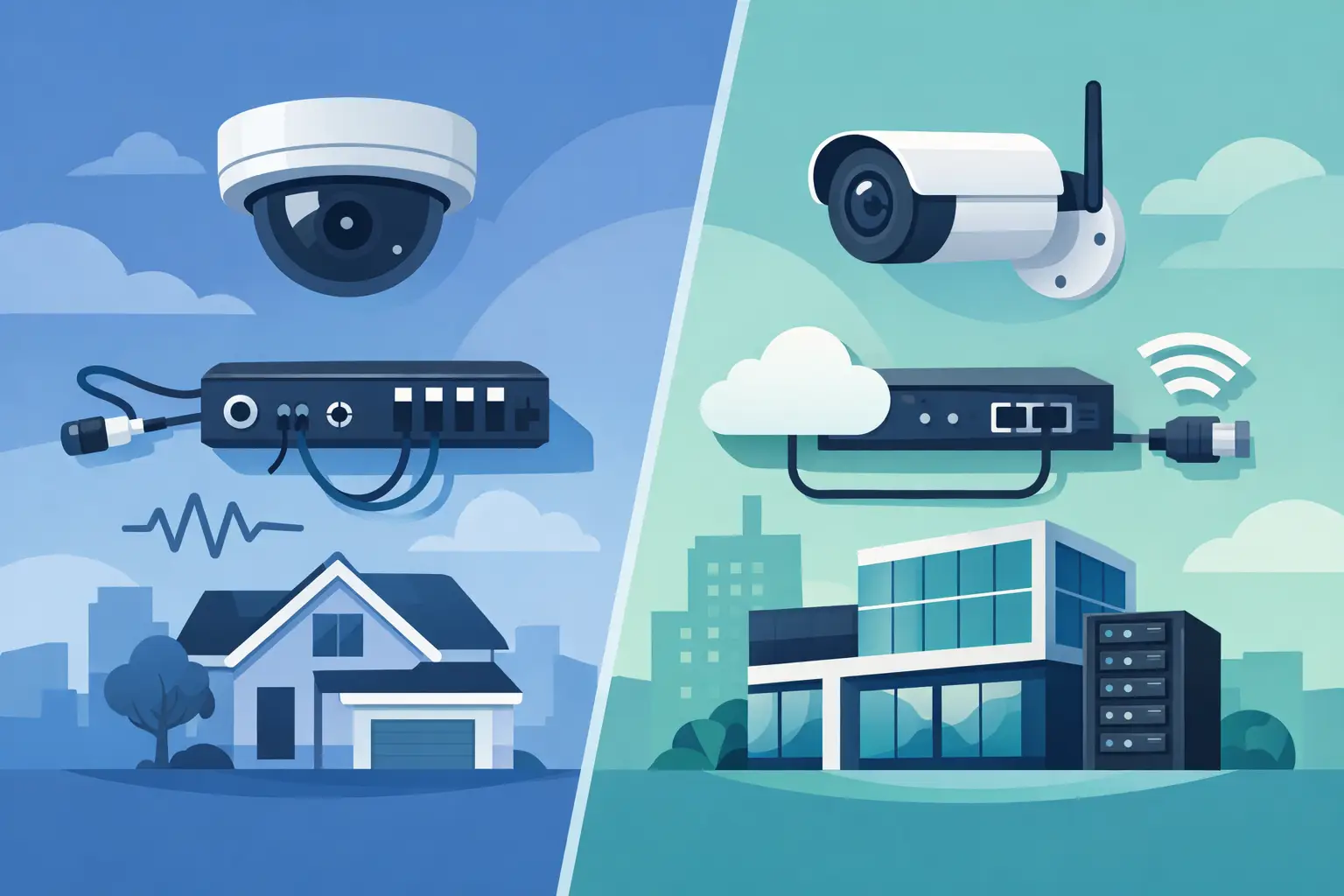
Analogue CCTV cameras send video back to a recorder through coaxial cable. Modern systems often use HD-over-coax technology, so they can deliver far better images than the older, grainy analogue cameras many people remember. The recorder converts and stores the footage, and can usually provide app-based remote viewing.
IP CCTV cameras are network cameras. Each camera processes video digitally and sends it across an Ethernet network to a network video recorder, known as an NVR, or in some cases to approved cloud storage. Power can often be supplied through the same network cable using Power over Ethernet, or PoE.
Both types can provide effective security when designed and fitted properly. The practical difference is that IP systems generally offer more detail and flexibility, while analogue systems can be a very sensible route for upgrading an existing installation without replacing cable runs.
Picture quality and identifying detail
Image quality is usually the first consideration. IP cameras are available in high resolutions and can retain useful detail across a wider area. This can help when a camera needs to cover a car park, yard, shop floor or long driveway, where identifying a face, clothing or vehicle registration may matter.
That does not mean every property needs the highest-resolution IP camera. More pixels can mean larger files, greater storage needs and more demand on the network. A poorly positioned 8MP camera may still be less useful than a well-positioned HD analogue camera covering a narrow entrance point.
Modern analogue CCTV can provide clear HD footage for common areas such as front doors, side gates, reception areas and smaller retail premises. If the aim is to see who approached a door or whether someone entered a restricted area, it may provide all the detail required at a more controlled cost.
Camera location, lighting and lens choice are just as important as resolution. A survey should consider sun glare, street lighting, reflections from windows, facial recognition angles and whether night-time coverage is needed. Infrared night vision is useful, but it is not a substitute for sensible lighting where a clear colour image is important.
Installation and existing cabling
For many property owners, the deciding factor is what is already in place. If an older system has sound coaxial cable routes, an analogue upgrade can often reuse them. This can reduce disruption, shorten fitting time and avoid unnecessary redecoration. A new compatible digital video recorder, known as a DVR, and HD cameras may transform the performance of an ageing system.
IP CCTV usually needs structured network cabling, network capacity and suitable recording equipment. It is often the preferred option for new builds, extensions, major refurbishments and larger sites where new cables can be planned properly. PoE can simplify installation because one cable carries both power and data, but it still needs to be correctly specified, tested and protected.
Wireless cameras have a place where cable installation is genuinely impractical, but they should not automatically be viewed as the easiest or most dependable answer. Wi-Fi range, interference, battery maintenance and signal loss can affect performance. For key coverage points, professionally installed wired cameras remain the more reliable choice.
Remote viewing and day-to-day use
Both analogue and IP systems can allow you to view live cameras and recorded footage through a smartphone, tablet or computer. This is valuable for homeowners checking a property while away, landlords monitoring vacant premises and business owners reviewing activity outside trading hours.
IP systems tend to offer more advanced functions. Depending on the equipment selected, this can include more refined motion detection, line-crossing alerts, people and vehicle filtering, search tools and integration with access control or other security equipment. These functions can save time when reviewing footage, particularly on a busy commercial site.
However, alerts need careful set-up. A camera that sends repeated notifications for passing traffic, branches or rain quickly becomes ignored. The goal is not to receive the most notifications. It is to receive useful notifications for the areas and times that matter.
For either system, remote access should be configured securely. Strong, unique passwords, up-to-date firmware and appropriate user permissions are basic safeguards. This is particularly relevant for IP CCTV because cameras sit on a network. A professional installer should leave the system working, explain how to use it and ensure access is not left open unnecessarily.
Reliability, storage and maintenance
A CCTV system should continue recording when you are not thinking about it. Analogue systems are often straightforward and self-contained, with fewer network dependencies between the camera and recorder. That simplicity can appeal to smaller homes and premises.
IP CCTV can be highly dependable too, but it relies more on good network design. The recorder, switch, cable quality, bandwidth and power supply all need to be suitable for the number and resolution of cameras. On larger installations, a poor network set-up can cause delayed images, missing footage or intermittent connection problems.
Storage should be specified around how long footage needs to be retained, how many cameras are recording and whether they record continuously or on motion. Higher-resolution footage consumes more storage, so a larger hard drive may be needed. It is better to agree a realistic retention period at the survey stage than discover after an incident that useful footage has already been overwritten.
Maintenance matters with both options. Lenses need cleaning, camera angles can shift, hard drives wear out and vegetation can gradually block a view. Regular checks also confirm that the date and time are accurate and that footage can be retrieved when required. For businesses and landlords, planned servicing gives confidence that the system remains fit for purpose rather than simply looking active.
Cost: look beyond the initial camera price
Analogue CCTV is commonly the lower-cost route where usable coaxial cabling already exists. The equipment can be more economical and installation can involve less labour. It is often an effective choice for a straightforward system with a modest number of cameras.
IP CCTV can cost more initially because of cameras, network equipment, cabling and higher storage requirements. Yet it may represent better value where greater detail, intelligent searching, flexible expansion or integration is needed. A business that repeatedly needs to investigate incidents across several areas may benefit from the time saved by a well-designed IP system.
The cheapest quote is not always the least expensive system in practice. Insufficient storage, unsuitable camera positions, unprotected external cables or poor app configuration can all lead to remedial work later. A clear specification should state the camera locations, intended coverage, recorder capacity, remote access arrangements and any ongoing service requirements.
Which CCTV system suits your property?
An analogue system is often a strong option if you have existing coaxial cabling, need dependable coverage of a small number of key areas and want to keep the upgrade cost proportionate. It is especially practical for homes, small shops and small offices where the coverage requirement is clear and contained.
An IP system is usually worth considering where image detail is a priority, the property is larger, cameras may be added later or more advanced alerts and search functions would be useful. It can be particularly suited to commercial premises, multi-entrance buildings, car parks and sites that need broader coverage.
There are also mixed situations. A property may retain well-positioned analogue cameras during a phased upgrade while adding IP cameras to a new extension or high-risk area. The best solution is not always an all-or-nothing replacement.
A site survey is the sensible starting point. It allows camera positions, cable routes, lighting, privacy considerations and the condition of any existing equipment to be assessed before a recommendation is made. ESI can advise on a system that fits the property rather than pushing a one-size-fits-all package.
The most reassuring CCTV system is the one that records the right areas clearly, is straightforward to use and is still working properly months after installation. Start with what you need to see and protect, then choose the technology that supports that job.