

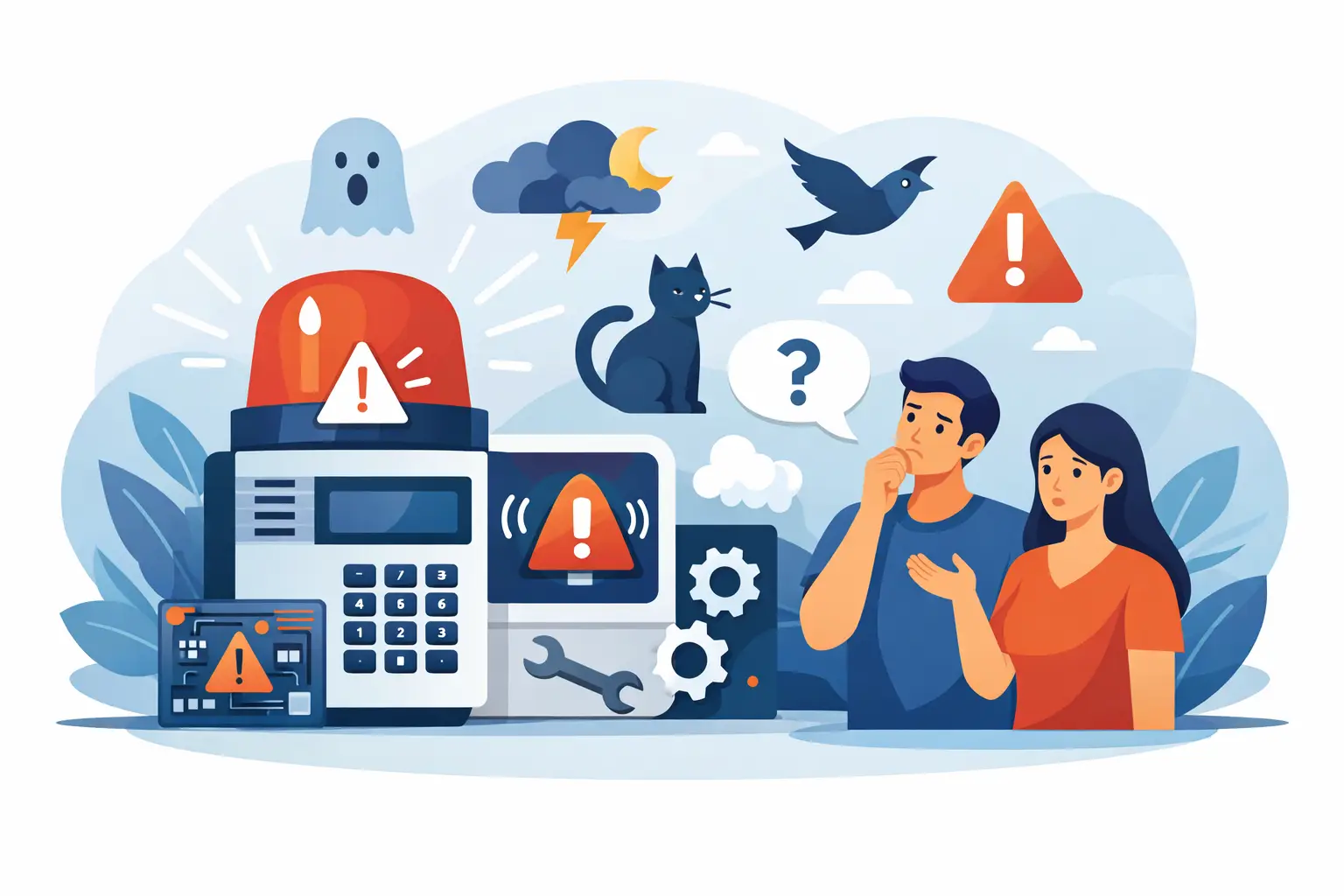
Few things undermine confidence in a security system faster than an alarm that keeps sounding for no clear reason. When people start searching for reasons alarms give false alerts, they are usually already dealing with disturbed nights, annoyed neighbours, wasted call-outs, or staff who no longer take the system seriously. The good news is that false activations are usually caused by a handful of identifiable issues, and most can be corrected with the right inspection, setup and maintenance.
A false alert does not always mean the system is poor quality. In many cases, it points to a sensor in the wrong place, an ageing component, a power issue, or a system that has not been serviced in some time. The fix depends on the type of alarm, the property layout and how the building is used day to day.
Common reasons alarms give false alerts
The most common cause is sensor placement. A detector can be technically fitted and still be in the wrong position for reliable use. Motion sensors placed near radiators, boilers, draughty doors, direct sunlight, or windows with changing light conditions can react in ways that look like movement to the system. In a commercial unit, this can happen near shutters, heaters or air conditioning outlets. In a home, it often shows up in conservatories, hallways or rooms with big temperature swings.
Another regular problem is user error, and that is not a criticism of the user. If a system is not intuitive, people will make mistakes. Entering the wrong code, opening the wrong entry route, setting part-arm and full-arm modes incorrectly, or forgetting a pet is in a protected area can all lead to an unnecessary activation. This is especially common in shared premises where multiple people use the system, such as small offices, shops, HMOs or busy family homes.
Low battery warnings are also ignored more often than they should be. In wireless alarm systems, detector batteries do not always fail all at once. One weak battery in a door contact, PIR or external sounder can cause inconsistent behaviour before the device stops working completely. Hardwired systems are not immune either. A backup battery inside the control panel can deteriorate with age and create faults, tamper warnings or unstable operation during power fluctuations.
Then there is wear and tear. Alarm systems work quietly in the background for years, but like any security equipment, they need attention. Loose contacts, tired batteries, sensor drift, damaged casing, moisture ingress and cable faults can all build up over time. A system that was dependable when first installed may become more sensitive or less stable simply because components are ageing.
Environmental issues that are easy to miss
Some of the most frustrating false alerts come from environmental factors that are not obvious at first glance. Insects inside a detector can trigger motion sensors. Spiders are a frequent culprit, particularly in corners, loft spaces, garages and outbuildings. Dust and debris can have a similar effect, especially where detectors have not been cleaned or where building work has recently taken place.
Draughts are another overlooked issue. If a PIR is mounted where warm and cool air move across the room unpredictably, it may react as though someone has entered the area. This is one reason alarm design should never be a simple case of fixing sensors where it is easiest to reach them. The room has to be assessed properly.
Commercial properties can present extra complications. Roller shutters, stock rooms, plant equipment and changing internal temperatures all affect performance. A detector that behaves perfectly in spring may become unreliable in winter if heaters are running at full output near the sensing area. Likewise, a sensor in a shop entrance can be influenced by repeated door openings, external temperature shifts and heavy footfall during trading hours.
Why poor installation causes repeat problems
One of the main reasons alarms give false alerts is that the system was not matched to the property in the first place. That might mean too few devices, the wrong type of detectors, rushed cable routes, poor device spacing or a control panel configured with unsuitable sensitivity settings.
This is where the difference between a professionally designed system and a quick fit becomes very clear. A proper survey considers entry points, room use, pets, heating sources, building layout, likely movement patterns and how the customer wants to use the alarm in practice. Without that groundwork, false alerts are more likely because the system is reacting to normal conditions it should have been designed around.
There is also the issue of expansion over time. A customer may add a smart element, convert a room, change doors, install new heating equipment or alter the layout of the premises. If the alarm settings are not reviewed after those changes, what worked before may no longer be appropriate.
Smart alarms and app-connected systems
Smart alarm systems can be very convenient, but they do add another layer to consider. If a device loses connection, has an outdated battery, drops signal strength or is paired incorrectly, the user may receive warnings or notifications that feel like false alarms. Sometimes the issue is not an intrusion trigger at all but a communication fault reported through the app.
This does not mean smart alarms are unreliable. In fact, when installed and maintained properly, they can be very effective. It simply means the setup needs to be right. Signal range, router position, firmware updates and device health all play a part. A smart system should still be treated as security equipment first, not just a convenient gadget.
For customers using Yale smart alarms or other connected systems, support matters. Many problems come down to configuration rather than hardware failure, and that is why clear handover and aftercare are so important.
How to reduce false alerts without weakening security
The answer is not to turn sensitivity down across the board or start omitting detectors until the problem appears to go away. That can create blind spots and leave the property less protected. The goal is to make the system accurate, not simply quieter.
Start with the basics. Check whether the false alerts happen at the same time of day, in the same area, or after a particular event such as arming the system, opening a certain door, or using heating equipment. Patterns matter because they point towards the real cause.
If the system is wireless, battery health should be reviewed across all devices, not just the one showing a warning. If it is hardwired, the panel battery, power supply and cable condition should be examined. Sensors should be inspected for dirt, signs of insect activity, loose covers and physical damage.
It is also worth reviewing how the alarm is used by everyone on site. In homes, that may mean checking entry and exit timings, pet settings and part-set arrangements. In businesses, it may involve retraining keyholders, adjusting access routes or creating clearer opening and closing procedures.
A proper service often resolves more than one issue at once. During servicing, an engineer can test devices, inspect panel history logs, identify recurring fault codes and assess whether detector placement still suits the building as it is now. That is usually more effective than replacing random parts and hoping for the best.
When a repair is enough and when an upgrade makes sense
Not every false alarm problem means the full system needs replacing. If the core equipment is sound and the issue is a worn battery, a faulty detector or an installation detail that can be corrected, a repair may be entirely sensible.
However, older systems can become uneconomical to maintain if faults are becoming frequent, spare parts are harder to source, or the equipment no longer suits the property. A dated alarm in a refurbished home or business unit may not provide the flexibility now needed. In those cases, an upgrade can reduce nuisance alerts while improving day-to-day usability.
That is often the point where customers benefit from a fresh survey rather than another short-term fix. A local installer such as Enga Security Installations can assess whether the problem is isolated or a sign that the system needs rethinking more broadly.
False alerts are not just an annoyance. Left unresolved, they train people to ignore the alarm, and that is the last thing any security system should do. If your alarm is sounding when it should not, treat it as a sign that something needs attention. With the right checks and a practical approach, most systems can be brought back to doing what they are meant to do – giving you confidence, not constant doubt.